A Comparative Measurement Study of
Commercial 5G mmWave Deployments
Arvind Narayanan*†, Muhammad Iqbal Rochman*‡, Ahmad Hassan†, Bariq S. Firmansyah§, Vanlin Sathya¶,
Monisha Ghosh‡, Feng Qian†, Zhi-Li Zhang†
†University of Minnesota - Twin Cities,
‡University of Chicago,
§Institut Teknologi Bandung, ¶Celona, Inc.
Abstract

5G-NR is beginning to be widely deployed in the mmWave frequencies in urban areas in the US and around the world. Due to the directional nature of mmWave signal propagation, improving performance of such deployments heavily relies on beam management and deployment configurations. We perform detailed measurements of mmWave 5G deployments by two major commercial 5G operators in the US in two diverse environments: an open field with a baseball park (BP) and a downtown urban canyon region (DT), using smartphone-based tools that collect detailed measurements across several layers (PHY, MAC and up) such as beam-specific metrics like signal strength, beam switch times, and throughput per beam. Our measurement analysis shows that the parameters of the two deployments differ in a number of aspects: number of beams used, number of channels aggregated, and density of deployments, which reflect on the throughput performance. Our measurement-driven propagation analysis demonstrates that narrower beams experience a lower path-loss exponent than wider beams, which combined with up to eight frequency channels aggregated on up to eight beams can deliver a peak throughput of 1.2 Gbps at distances greater than 100m.
5G Experiments in the Wild
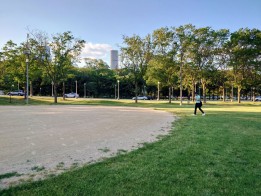
Experiments @
Baseball Park, Chicago

5G mmWave (OpX)
transceiver in Upper Hutchinson Field Baseball Park, Chicago

5G mmWave (OpX)
transceiver in Downtown Chicago
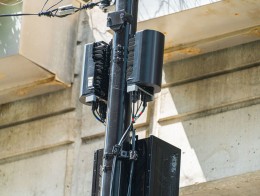
5G mmWave (OpY)
transceiver in Downtown Chicago